Naming
Margot Käßmann School





Naming is leadership: How three schools became a values-driven brand.
Starting point
The three vocational schools of Diakonie Rotenburg merged to form the region’s largest training centre for nursing, health and social care.
What was missing: a shared name that respects over 100 years of tradition, emotionally connects the new entity, and presents a clear profile in the competition for talent.
The goal: an identity that conveys competence and trust –
for training with a future.
Challenge
The starting point was complex: three strong shareholders, a long history, and a naming process that had already been discontinued without results. It was clear: the new name had to be more than a compromise.
As a major employer and a pillar of skilled labour development in northern Lower Saxony, expectations for the new brand were high.
Our role
Human Centric Branding developed the strategic naming platform, facilitated the participatory decision-making process, and led the complete brand development – from naming and stakeholder alignment through to the corporate design system and brand film.
Solution
- Name as a statement: Instead of a purely functional school name, we developed the concept of a “brand identity with a face”.
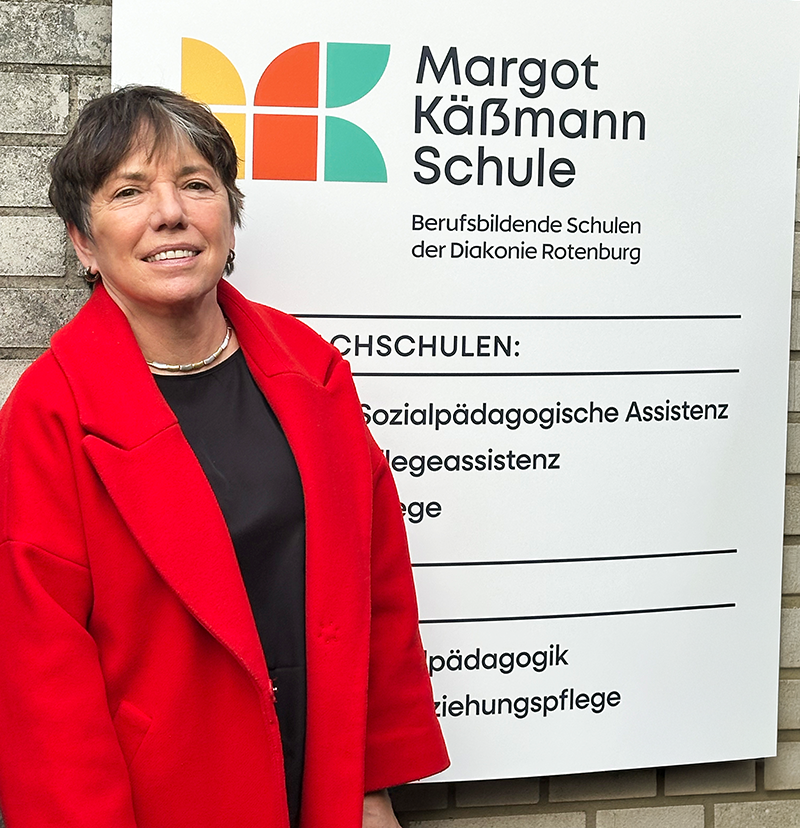
- The idea: Margot Käßmann as namesake and patron. She is Germany’s best-known Protestant theologian, a strong voice for social cohesion, and a credible advocate for social professions.
- The process: Strategy development based on our SENSUS methodology. Definition of factual evaluation criteria and facilitation of a multi-stage voting process involving all 600 students and teachers. The result: a unanimous decision.
Corporate Design
- Symbolism: The logo combines the initials of the namesake with Diakonie’s crown cross.
- System: A modular design system with three colours representing the three supporting organisations.
- Content: A brand film featuring Dr Margot Käßmann conveys the brand authentically and credibly.
Success
- Uniqueness: Germany’s first Margot Käßmann School. High media attention.
- Identification: A committed patron as a meaningful role model for the predominantly female student body.
- Culture: Naming as a cultural catalyst: from a complex merger to a sense of “we”.
- Efficiency: The SENSUS methodology created confidence and accelerated the process.
Conclusion
Naming is leadership.
The name “Margot Käßmann School” is anything but comfortable in the church education context.
It is clear, visible and polarising – and that is precisely why it is right.
Human Centric Branding prepared this bold step strategically and facilitated it with confidence. The participatory approach built trust and made the naming process the cultural starting point for the new school.
This is how a merger grew into a shared identity.